Abstract
The goal of this assignment was to select and observe an online community through social media platforms, forums, or blogs in order to study its behaviors and language. This research was developed into a 6–8 page analytical paper that examined patterns, trends, and broader social significance. The essay strengthened my ability to observe critically, conduct research, and form informed interpretations about digital communities.
The Concept of Sora by OpenAI
In the age of information, artificial intelligence has advanced in ways beyond our comprehensive imagination, abilities, and creations. The history of artificial intelligence is rooted in generational ideas that span from the 1950s, thanks to computer scientist and mathematician Alan Turing who paved the way for AI. From Turing’s iconic question “Can machines think?”, he shifts the focus from theoretical and philosophical ideas to practical and experimental ideas for the development of neural networks and machine learning, shaping the digital age. AI has evolved from a theoretical idea to a practical force shaping digital culture. One of the most notable examples of this radical change is Sora, a text-to-video generator software by OpenAI that allows people to make very realistic, vivid clips from written prompts. With this innovation, the vast majority of digital communities across social media platforms have found themselves experimenting with Sora’s creative capabilities – specifically those sharing hyperrealistic results. This sets the stage for modern computational approaches to AI, making Turing’s inquiry to “Can machines think?” a pivotal moment in the history of artificial intelligence, leaving a consequential trace in society from ways which online communities interact with AI across the media today.
Ever since AI has been integrated into society, evolving tremendously, it has generated many fears, excitements, and predictions about the future of AI. This is possible now that high-tech, hyper-realistic video generator apps have been introduced for thousands to operate, capable of transforming text prompts and images into deepfakes, blurring the dividing lines between the real and the artificial, ethics and innovation, and telling between machines to humans. One of the most notable tools in this space is Sora AI, a popular machine language developed by OpenAI, the AI research and development company that created ChatGPT, another famous conversational AI chatbot. In the vast majority of media outlets such as Reddit, Tiktok, and (X) Twitter, users have found communities centered around experimenting with Sora’s capabilities – testing its limits, sharing results, and debating its ethical consequences. Within these spaces, users make a variety of content, from humorous meme-style clips and fictional scenes to short tapes of public figures portrayed in unnatural ways, confusing what’s true and what’s not. While AI videos of certain figures have stirred some controversial disputes, curiosity, playfulness, and technical exploration is also reflected in the community’s pursuit. In exploring the problems behind the use of AI, this paper will highlight the impact on how Sora AI deepfake creators and members among this community communicate to each other, use language, express their creativity, and negotiate the cultural and ethical boundaries of AI-generated content from creators who share these posts consistently.
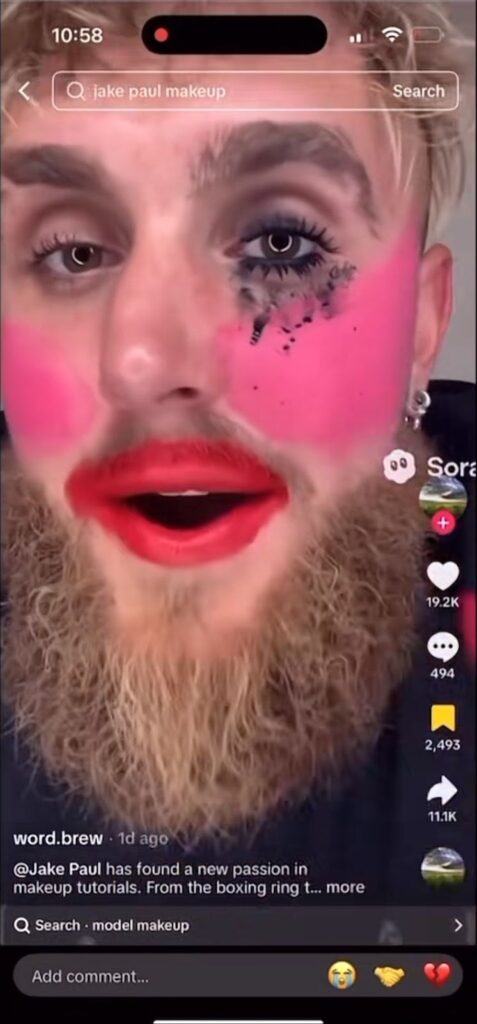
Figure 1. Screenshot of an AI-generated TikTok video parodying influencer Jake Paul in a makeup tutorial, shared by user @word.brew, October 2025.
This AI generated video shows the Youtuber-turned-boxer Jake Paul “coming out” as gay and putting on makeup, gaining traction within Sora-related content feeds. Community members respond using humorous and ironic rhetoric, blurring the lines between legitimacy, parody, and digital experimentation. Through playful and sarcastic skits, Jake and other celebrity figures have found themselves at the center of a bizarre new AI trend.
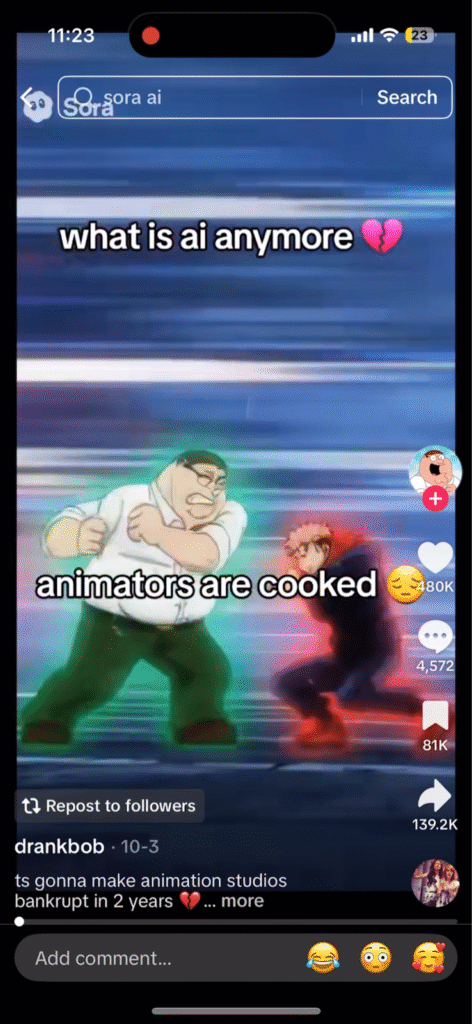
Figure 2. Screenshot from an AI-generated TikTok video depicting Peter Griffin (from Family Guy) fighting Itadori Yuji (from Jujutsu Kaisen), created with Sora AI and shared by user @drankbob in October 2025 (TikTok, 2025).
This absurd crossover parody signals how Sora AI users experiment with Sora’s generative potential to create animations and in this case, the two animated characters from two separate animated shows, Family Guy and Jujutsu Kaisen who are fighting. Viewers bantered with nostalgia, mockery, amazement, and curiosity, expressing their own fan identities while Sora’s unbelievable creative potential is being showcased.
Since the spread of AI-generated content exists widely across the media, this has many users posting or reposting deepfake videos of well-known individuals, where they are shown doing or saying something that never existed or happened in the real world. On Reddit, one of the many active spaces for this type of content is the r/SoraAi subreddit – a creative channel dedicated to OpenAI’s model. The community features over sixty seven thousand individuals, as some exchange advice on bettering realism or quality, post their generated videos, while others treat AI-generated content as a neutral or even playful experiment with the software’s capacity. Then I noticed there was a ritual where members displayed their creations and many of their posts began like: “Here’s my video using Sora …” or “Look what I made” while also giving feedback. There was also another pattern of peer‐help troubleshooting, comments that say things like: “Why do my videos look like garbage? What am I doing wrong in the prompt?” and viewers then send their own critiques, trading prompts for review and correction, and commemorating for achieving accuracy that’s closer to real life, as the discussion’s atmosphere embodies fascination and drive. The atmosphere, being collaborative yet experimental, reflects how creators online approach AI as both experimental and as a creative asset.
While I was observing the subreddit, I encountered a post on Reddit that set off a roar of debate in the comments, featuring an AI-generated video of the late comedian and Academy Award–winning actor Robin Williams tap dancing. The reactions to the AI-generated video from the comments section appeared, mixed with pity for William’s family, disgust, and dark humour. Users expressed shock, pleading to stop making videos of dead people and how disrespectful it is to his and his family’s legacy, calling it “gross” and “disrespectful.” while others treated it insensitively, as harmless content or even as an experimental form of digital art, praising the realism. One user responded to a critic with contempt, writing, “Why? They’re dead? Genuinely asking. If I’m dead, why would I care?” (AggravatingFuture437). The rest responded with outrage and annoyance, criticizing the creators of “digital necromancy” and “puppeteering a corpse for laughs.” This rebuttal exposes a distinct ethical dilemma within the community—between those who view AI as morally bound and those who see it as being desensitized from emotional or moral conflicts. Then the discussion circles around how differing stances on approval, creativity, and respect for the dead shape broader tensions surrounding AI-generated content, in which the post expresses how humor and grudge coexist in AI communities.
It became very evident once I came across their lack of comprehension of the dangers of AI and the impact that it has on people who are targeted with it, how their reaction is less about an ethical consensus that such content is inappropriate. With the fact that users negotiate the ethics of AI through many ideas like humor, irony, and confrontation, they tend to overlook certain boundaries between entertainment and misdeed. The thread turns less about Robin Williams himself and leans further into what the definition of “create” is in a space where posting exists without consent, authenticity, and empathy and most of the time, it becomes visible how this space was less in a unified position than in a broken moral ecosystem.
On Twitter, an entertainment news account called PopBase shared a tweet announcing that Robin Williams’ daughter, Zelda Williams, had publicly asked people to stop sending her videos generated by AI of her deceased father, inviting plenty of replies, likes, and reposts, welcoming several expressions of concerns, anger and honest critique from the audience. From my investigation, the vibe of the digital space felt intensely direct, with the energy unfolding from a combination of compassion to an atrocious temperament. More users expressed dislike, naming the videos “disrespectful,” “gross,” or “weird,” whereas others responded with dark humor or sarcasm, tweeting things like “man made horrors beyond comprehension,” “this will have the opposite effect sadly,” or “PopBase delete your tweet.” A few participants sent emojis such as “💀😭🔥” as a way to punctuate their reactions, weaving the thread with an almost dramatic and comical tone common of Twitter’s energetic culture. The bulk of the discussion points to how AI needs to be regulated, stopped or completely removed, to the extent that AI isn’t accessible, while criticizing AI and people who produce these inconsiderate artless creations and for not respecting boundaries. Most were in disbelief, disappointment, and even bitterness, with their way of language heavily influencing the point they were trying to make. Such exchanges reveal the conflicting ideologies and cultural values that shape how digital communities understand and react to artificial intelligence. Some see AI as a threat to human authenticity and disrespect for the dead, while others see it as an inevitable and even creative extension of technology. All in all, certain limits of creativity are being discussed in the age of machine learning, based on circulations that highlight how users throughout social media consistently negotiate questions of genuineness and approval.
Surrounding Sora, a recent study of public commentary found that while the tool is commemorated for its creative prospect, the users of the community that prioritize it are also predetermined by certain demographic and professional profiles. In their paper, Zhou et al. report that among the 292 sampled comments under Sora-related posts, many originated from “creative professionals,” media-makers, and trendsetters as opposed to casual hobbyists. The authors note that these users often bring prior professional experience in digital design or video editing, suggesting that Sora’s community is less demographically random and more concentrated in tech-savvy and creative industry circles. The study emphasizes that although Sora’s public discourse focuses on mainstream influence (industry disruption, viral videos, celebrity deepfakes), the user community also seems to maintain specific norms and social structures: a majority with advanced educational backgrounds, professional media experience, stressing over experimentation and peer critique.
Regardless, the Sora AI community functions as an open-source creative organism unlike traditional art collectives. It serves simply as a space where collaboration, experimentation, and critique happen simultaneously in comment sections and Discord calls. Members send their results like artists distribute drawings and trade prompts, constantly inquiring with each other to shift the limitations of generative media. However, beneath the consistency of collaboration lies a social structure shaped by competition, ethics, and digital commissioning. Seeing how creators caption their work like “Why does my video look like garbage?” or “Look what I made!” reveals an evolving language of self-promotion and appraisal, driven by algorithmic visibility and peer feedback. In this sense, Sora’s users aren’t just technologists; they’re cultural participants redefining what the standards of tangible art truly are in the 21st century. The discourse they build —sometimes chaotic, sometimes profound — offers a glimpse into how creativity survives and adapts under the weight of the computerization of social media.
Works cited
u/Charming_Sock6204. “Robin Williams tap dances about the Epstein Files.” Reddit, r/SoraAi, 7 Oct. 2025, www.reddit.com/r/SoraAi/comments/1nzuo6s/robin_williams_tap_dances_about_the_epstein_files/
Pop Base (@PopBase). “Robin Williams’ daughter Zelda Williams asks fans to stop sending her AI-generated videos of her late father.” X (formerly Twitter), 8 Oct. 2025, 3:45 p.m., https://x.com/popbase/status/1975717180206686366
Zhou, Ming, Aisha Rahman, and Carlos de la Cruz. “Demographic and Behavioral Trends Among AI Video Creators in Online Communities.” Journal of Media Technology and Society, vol. 12, no. 3, Spring 2024, pp. 145–172.

